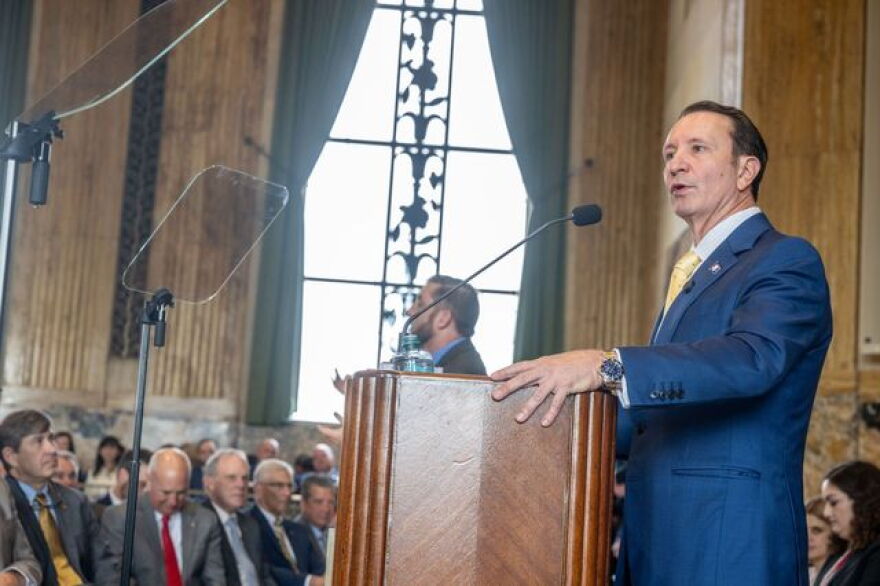
A three-week freeze on Louisiana funding for nonprofits and local governments has ended, but the political dispute that caused it is only beginning.
Gov. Jeff Landry’s administration and State Treasurer John Fleming have tightened the process used to distribute money that lawmakers placed in the state budget for nongovernmental organizations. The changes are intended to prevent fraud and make recipients document how public dollars are spent before most of the money leaves the Treasury.
Legislators from both parties agree that taxpayer funds need safeguards. Their objection is that the executive branch changed the rules after the Legislature had already approved the appropriations, temporarily stopping money for organizations that had built programs and budgets around the state’s commitment.
The debate surfaced publicly Thursday before the Joint Legislative Committee on the Budget. Fleming told lawmakers that payments had restarted but that his office was still working through a backlog, according to reporting from the Louisiana Illuminator and WBRZ.
Treasury paused disbursements from Oct. 21 through Nov. 13 while the administration, the state inspector general and the treasurer worked through new requirements.
## What the new rules require
The 2026-27 state budget contains approximately $113.5 million for 272 nonprofit organizations, according to the governor’s office. Treasury administers most of that amount.
The revised process requires more information about vendors and subcontractors, stronger fraud checks, additional financial documentation and a cap on certain administrative costs. It also shifts most payments toward reimbursement after expenses have been documented.
Advance payments, when approved, generally would be limited to 25% of an organization’s allocation rather than the 50% advances sometimes allowed previously. Commissioner of Administration Taylor Barras told lawmakers that exceptions could be considered when an organization demonstrates a need for more flexibility.
Landry’s office argues that the controls address weaknesses already visible in state records. In an Oct. 21 release, the governor and Inspector General Angele Davis cited four nonprofit allocations with questionable spending, incomplete documentation or weak contract terms.
One case involved a $400,000 advance from an $800,000 appropriation. The governor’s office said a Legislative Auditor review found that more than $205,000 moved out of the dedicated account before required reports were filed, and Treasury stopped the second payment.
Another case involved a $37,500 advance to Divine Kingdom Ministries. A subsequent investigation led to the organization’s director being arrested on allegations of theft and filing false public records. Those charges remain allegations unless proven in court.
The administration also identified two unnamed recipients with concerns involving related-party spending, unidentified subcontractors or unusually broad administrative fees.
Those examples support the argument for better screening before payment. They do not establish that most nonprofit recipients have misused state funds.
## Why legislators are objecting
The policy fight is partly about timing.
The fiscal year began July 1, and lawmakers approved the nonprofit allocations during the spring legislative session. Senate President Cameron Henry, a Republican, argued that imposing stricter standards in the middle of the budget cycle blurred the constitutional line between the Legislature’s power to appropriate money and the executive branch’s responsibility to carry out those decisions.
Democratic lawmakers raised a different but related concern: smaller food banks, senior programs and community organizations may not have enough cash to perform state-funded work first and wait for reimbursement later.
That risk is practical, not theoretical. A large institution can often borrow or use reserves while it waits for government payment. A neighborhood nonprofit may have no such cushion. A rule designed to reduce taxpayer exposure can therefore favor larger organizations even when a smaller group has a sound program and a clean record.
Lawmakers also questioned why all payments were stopped while the state investigated a small number of suspect cases. The four examples identified by the administration total less than $750,000, while the current year’s nonprofit appropriations exceed $113 million.
As a compromise, the administration and Treasury agreed that agreements completed before Dec. 15 could proceed without applying the full new framework retroactively, according to the Illuminator. Payments have resumed, but the backlog remains.
## A legitimate oversight goal—and a power struggle
Landry’s approach is part of his broader Louisiana Taxpayer Protection Initiative. Executive Order JML 26-069, issued in July, directs the inspector general to strengthen fraud detection and coordinate with state and federal partners. The administration has described the nonprofit rules as an extension of that effort.
The policy has an obvious public-interest rationale. Once improperly spent money leaves the state, recovering it can be difficult and expensive. Requiring vendor identification, bank records and proof of performance before reimbursement can prevent losses that an audit might discover too late.
The counterargument is not that oversight is unnecessary. It is that the executive branch should not use administrative controls to effectively reconsider appropriations that the Legislature already enacted, especially without giving recipients time to adjust.
That is where the dispute becomes constitutional and political. Louisiana’s governor has considerable power over budgeting and administration, but the Legislature decides where state money is appropriated. A payment process that is so restrictive that approved funds cannot realistically be accessed could function like a partial veto after the budget becomes law.
That conclusion has not been established by a court. It is the central concern lawmakers are raising.
The most durable solution would separate two questions that have become tangled together: whether the state should strengthen nonprofit oversight, and when new rules should take effect. Louisiana can require better documentation and anti-fraud controls while giving legitimate recipients clear standards before a fiscal year begins.
For now, the money is moving again. The larger test will be whether the new system stops abuse without starving effective community programs or allowing the executive branch to rewrite legislative spending decisions after the fact.